
AURORA 2025 Winner Lưu Thị Trang Publishes in Springer Nature: MOF Hydrogel Removes 98% of Microplastics
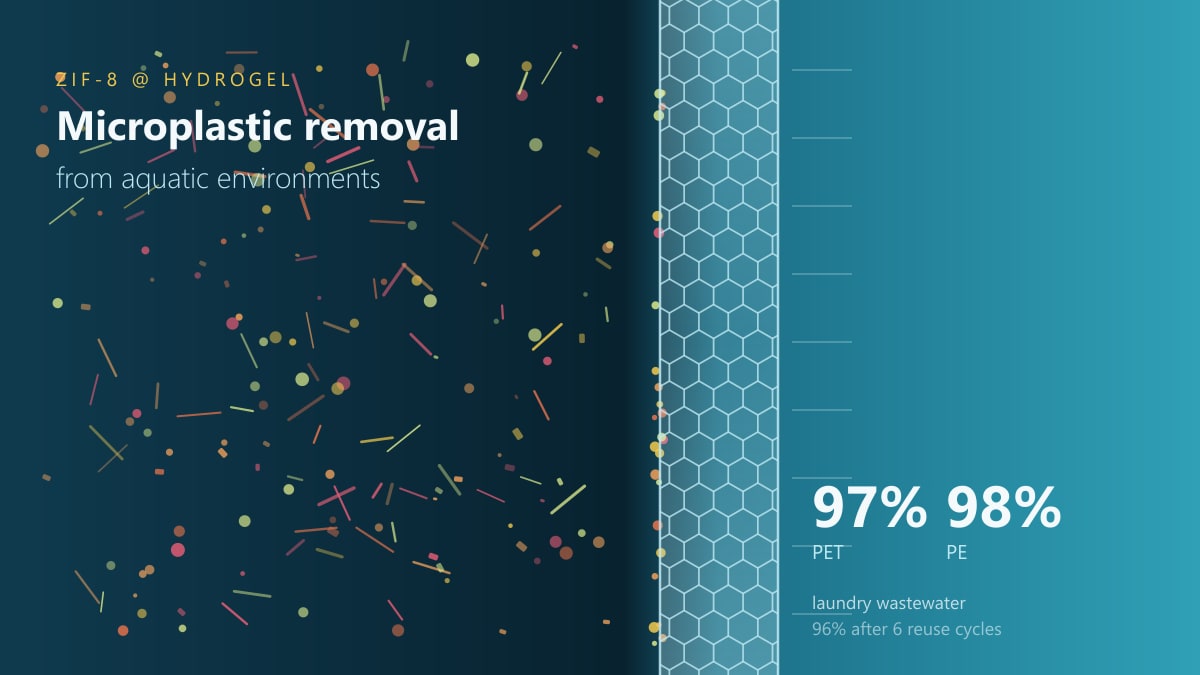
Lưu Thị Trang — AURORA 2025 Third Prize winner, PhD candidate at the University of Technology Sydney and lecturer at Hanoi Architectural University — is first author of a paper published open access in Environmental Science and Pollution Research (Springer Nature) on 1 September 2026.
A powder that could never leave the laboratory
Metal–organic frameworks capture microplastics extremely well. Their porosity is enormous, and the positively charged metal centres pull in microplastic particles, which carry a negative surface charge in water. On paper they are close to ideal.
The obstacle has never been chemistry. It is physical form. MOFs exist as fine, loose powders. Pack them into a working filter and the structure collapses, so the material cannot survive continuous flow. That single limitation is why MOF adsorption has stayed a laboratory result for years, with reported microplastic removal of only 32.6% and 76.5% in earlier studies.
The approach: give the powder a skeleton
Rather than search for a better sorbent, the study makes the existing one deployable. ZIF-8 is locked inside a double-network hydrogel of PVA and PEGDA, cured under UV light for ten minutes, then freeze-dried into a solid disc. What comes out is not a powder in a bag — it is a mechanically stable membrane you can run water through.
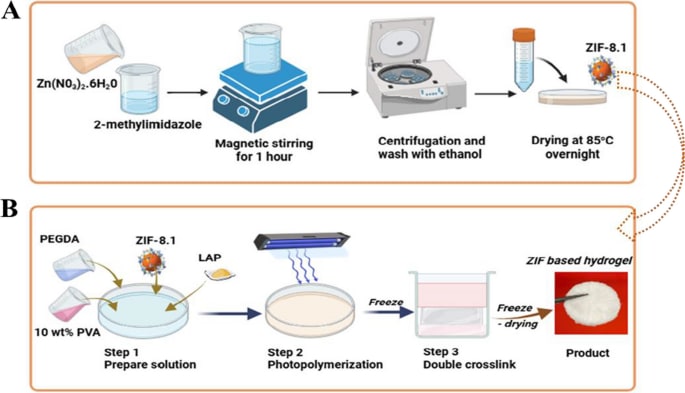
Cách chế tạo vật liệu. (A) ZIF-8 kết tủa từ kẽm nitrat và 2-methylimidazole, rửa và sấy khô. (B) Bột được trộn với PVA, PEGDA và chất khơi mào quang, đóng rắn dưới tia UV, khâu mạch kép rồi đông khô thành đĩa rắn.
The finished filter is a disc 30 mm across and 2.5 mm thick, tested in a continuous-flow column at 1.2 litres per hour.
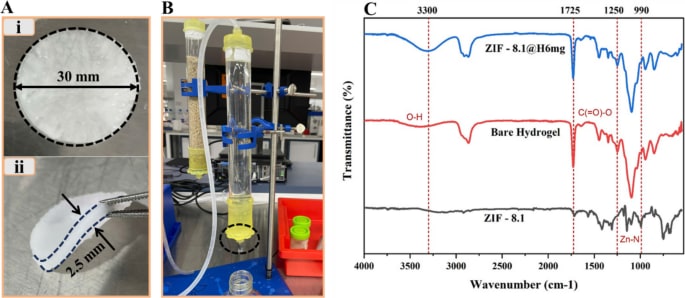
Màng lọc và hệ thống thử nghiệm. (A) Đĩa thành phẩm. (B) Cột lọc dòng chảy liên tục. (C) Phổ FTIR cho thấy ZIF-8 liên kết hoá học vào hydrogel chứ không chỉ trộn lẫn.
The results
Tested on real laundry wastewater — one of the largest sources of microplastic pollution — the optimised composite removed 97% of PET and 98% of PE. It still removed 96% after six reuse cycles, and ran stably for about four hours, with backwashing extending filtration further.
The comparison inside the study is the telling one: a plain hydrogel with no ZIF-8 manages only 65% and 52%. The metal–organic framework is doing the work; the hydrogel simply makes it usable.
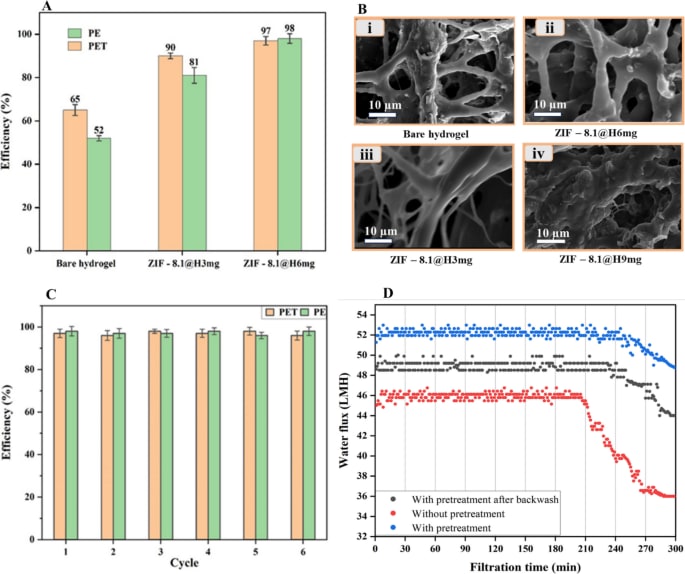
Loại bỏ được gì, và bền bao lâu. (A) Hiệu suất tăng theo hàm lượng ZIF-8. (B) Ảnh SEM cấu trúc lỗ. (C) Hiệu suất qua sáu chu kỳ tái sử dụng. (D) Lưu lượng nước trong năm giờ, có và không có tiền xử lý cùng rửa ngược.
Trang's role
She is first author. The paper's contributions statement records her leading the conceptualisation, the methodology and the formal analysis — and writing the original manuscript on her own. The work is authored across her two appointments, at UTS and at Hanoi Architectural University.
Bản tiếng Việt
Lưu Thị Trang — Giải Ba AURORA 2025, nghiên cứu sinh tại Đại học Công nghệ Sydney (UTS) và giảng viên Đại học Kiến trúc Hà Nội — là tác giả thứ nhất của bài báo công bố truy cập mở trên Environmental Science and Pollution Research (Springer Nature) ngày 1/9/2026.
Thứ bột không rời nổi phòng thí nghiệm
Vật liệu khung cơ kim (MOF) bắt vi nhựa rất giỏi. Độ xốp cực lớn, và các tâm kim loại mang điện dương hút lấy hạt vi nhựa vốn tích điện âm trên bề mặt khi ở trong nước. Trên lý thuyết, đây gần như là vật liệu lý tưởng.
Trở ngại chưa bao giờ nằm ở hoá học, mà ở hình thái vật lý. MOF tồn tại dưới dạng bột mịn, rời. Nhồi vào một bộ lọc vận hành thật thì cấu trúc vỡ ra, vật liệu không trụ được trước dòng chảy liên tục. Chính hạn chế đó khiến MOF nhiều năm liền chỉ là kết quả trong phòng thí nghiệm, với hiệu suất loại bỏ vi nhựa công bố trước đây chỉ đạt 32,6% và 76,5%.
Cách giải: cho thứ bột ấy một bộ khung
Thay vì đi tìm chất hấp phụ tốt hơn, nghiên cứu này làm cho chất vốn đã tốt trở nên dùng được. ZIF-8 được khoá vào mạng hydrogel kép PVA và PEGDA, đóng rắn dưới tia UV trong mười phút, rồi đông khô thành đĩa rắn. Thứ thu được không còn là bột trong túi, mà là một màng lọc bền cơ học cho nước chảy qua.
Màng thành phẩm là đĩa đường kính 30 mm, dày 2,5 mm, thử nghiệm trên cột dòng chảy liên tục ở lưu lượng 1,2 lít mỗi giờ.
Kết quả
Thử trên nước thải giặt là thật — một trong những nguồn phát thải vi nhựa lớn nhất — vật liệu tối ưu loại bỏ 97% PET và 98% PE. Sau sáu chu kỳ tái sử dụng vẫn đạt 96%, chạy ổn định khoảng bốn giờ, và rửa ngược giúp kéo dài thêm thời gian lọc.
Phép so sánh ngay trong nghiên cứu mới là điều đáng chú ý: hydrogel trơn không có ZIF-8 chỉ đạt 65% và 52%. Khung cơ kim mới là thứ làm việc; hydrogel chỉ khiến nó dùng được.
Vai trò của chị Trang
Chị là tác giả thứ nhất. Phần ghi nhận đóng góp của bài báo ghi rõ chị chủ trì xây dựng ý tưởng, phương pháp và phân tích dữ liệu — đồng thời tự mình viết toàn bộ bản thảo gốc. Công trình mang tên cả hai nơi chị công tác: UTS và Đại học Kiến trúc Hà Nội.
Read the paper / Đọc bài báo gốc: Springer Nature — open access
Full bilingual summary / Tóm tắt song ngữ đầy đủ: NIC AU Resources
Figures from Luu et al. (2026), Environmental Science and Pollution Research, reproduced under CC BY 4.0. Resized for the web; no other changes.