Integrated valorization of durian rind into bioactive carboxymethyl cellulose hydrogels: Co-recovery of flavonoids and cellulose with physicochemical, functional, and economic evaluation
Tận dụng tích hợp vỏ sầu riêng thành hydrogel carboxymethyl cellulose có hoạt tính sinh học: Đồng thu hồi flavonoid và cellulose cùng đánh giá lý hoá, chức năng và kinh tế
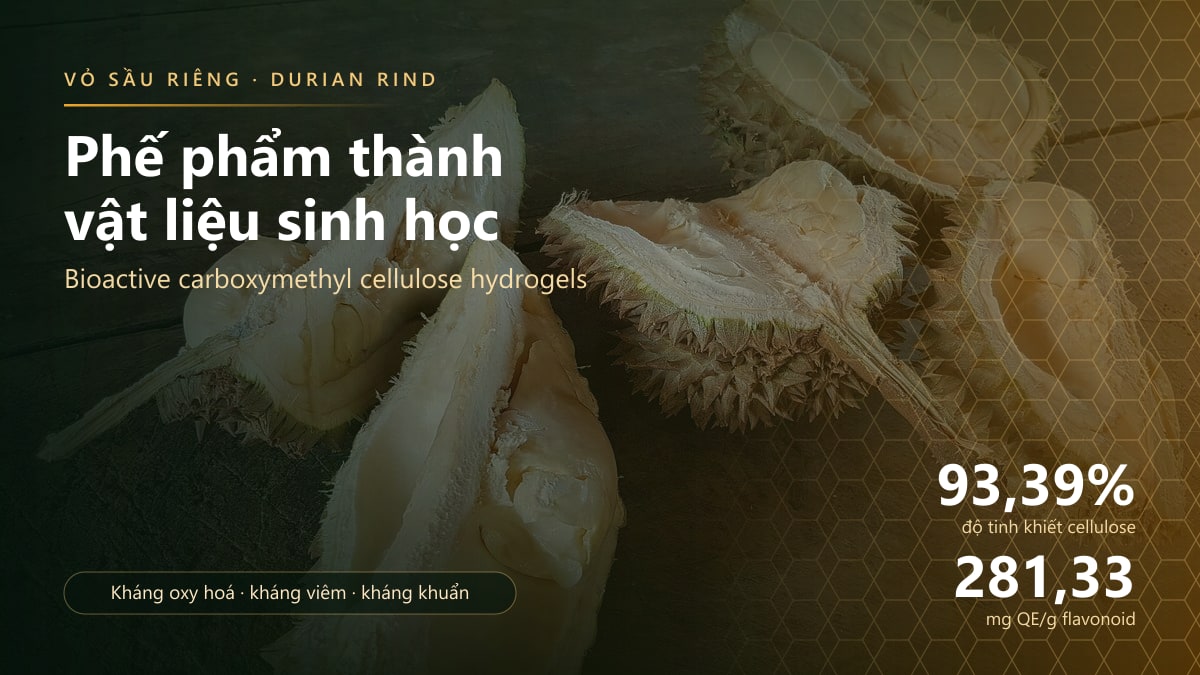
Vietnam discards hundreds of thousands of tonnes of durian rind every year. This study treats that waste as two products rather than one: a single integrated process recovers the flavonoids first, then converts the residual husk into carboxymethyl cellulose and casts it into a hydrogel — so nothing is thrown away between steps. Citric acid at 10% extracted 281.33 mg QE/g of flavonoids, and the remaining biomass yielded cellulose at 27.10% with 93.39% purity. The resulting hydrogel releases its payload steadily over 24 hours and is bioactive in its own right: antioxidant, anti-inflammatory and antibacterial against three pathogens. The paper closes with a costing, which is the part most valorisation studies leave out.
- One process, two products: flavonoids and cellulose are co-recovered from the same durian rind, with the residue from the first step feeding the second rather than becoming waste.
- Citric acid at 10% was the optimal extraction medium — 281.33 mg QE/g of total flavonoids, and cellulose recovered at 27.10% yield with 93.39% purity.
- The carboxymethyl cellulose hydrogel released 65.34% of its load over 24 hours, a controlled profile rather than a burst.
- Bioactive as made: antioxidant IC₅₀ of 55.75 µg/mL (DPPH), anti-inflammatory IC₅₀ of 610.70 µg/mL (BSA denaturation), and 10–14 mm inhibition zones against Staphylococcus aureus, Bacillus subtilis and Escherichia coli.
- Includes an economic evaluation of the integrated route — the step that decides whether a valorisation process ever leaves the laboratory.
- Dr Nguyễn Hoàng Chinh (Deakin University) is the senior (last) author of the nine-author team, which spans Ton Duc Thang University, Deakin and Texas A&M.
- Open access under CC BY-NC-ND — free to read.
Mỗi năm Việt Nam thải ra hàng trăm nghìn tấn vỏ sầu riêng. Nghiên cứu này coi phần phế phẩm đó là hai sản phẩm chứ không phải một: một quy trình tích hợp duy nhất thu hồi flavonoid trước, rồi chuyển phần vỏ còn lại thành carboxymethyl cellulose và tạo thành hydrogel — nên không có gì bị bỏ đi giữa các bước. Axit citric nồng độ 10% chiết được 281,33 mg QE/g flavonoid, phần sinh khối còn lại cho cellulose với hiệu suất 27,10% và độ tinh khiết 93,39%. Hydrogel thu được nhả hoạt chất đều đặn trong 24 giờ và bản thân nó cũng có hoạt tính: chống oxy hoá, kháng viêm và kháng khuẩn trên ba chủng gây bệnh. Bài báo kết thúc bằng phần tính toán chi phí — phần mà phần lớn nghiên cứu tận dụng phế phẩm thường bỏ qua.
- Một quy trình, hai sản phẩm: flavonoid và cellulose được đồng thu hồi từ cùng một lượng vỏ sầu riêng, phần bã của bước đầu trở thành nguyên liệu cho bước sau thay vì thành rác.
- Axit citric 10% là môi trường chiết tối ưu — thu 281,33 mg QE/g flavonoid tổng, và cellulose đạt hiệu suất 27,10% với độ tinh khiết 93,39%.
- Hydrogel carboxymethyl cellulose nhả 65,34% lượng hoạt chất trong 24 giờ — một đường cong nhả có kiểm soát, không phải nhả ồ ạt.
- Có hoạt tính ngay từ dạng chế tạo: chống oxy hoá IC₅₀ 55,75 µg/mL (DPPH), kháng viêm IC₅₀ 610,70 µg/mL (ức chế biến tính BSA), và vòng vô khuẩn 10–14 mm trên Staphylococcus aureus, Bacillus subtilis và Escherichia coli.
- Kèm đánh giá kinh tế cho toàn tuyến quy trình tích hợp — bước quyết định một quy trình tận dụng phế phẩm có ra khỏi phòng thí nghiệm được hay không.
- TS. Nguyễn Hoàng Chinh (Đại học Deakin) là tác giả cuối (tác giả chính chịu trách nhiệm) trong nhóm chín tác giả, thuộc Đại học Tôn Đức Thắng, Deakin và Texas A&M.
- Truy cập mở theo giấy phép CC BY-NC-ND — đọc miễn phí.