
Durian Rind to Bioactive Hydrogel: Dr Nguyễn Hoàng Chinh Publishes in Food Hydrocolloids
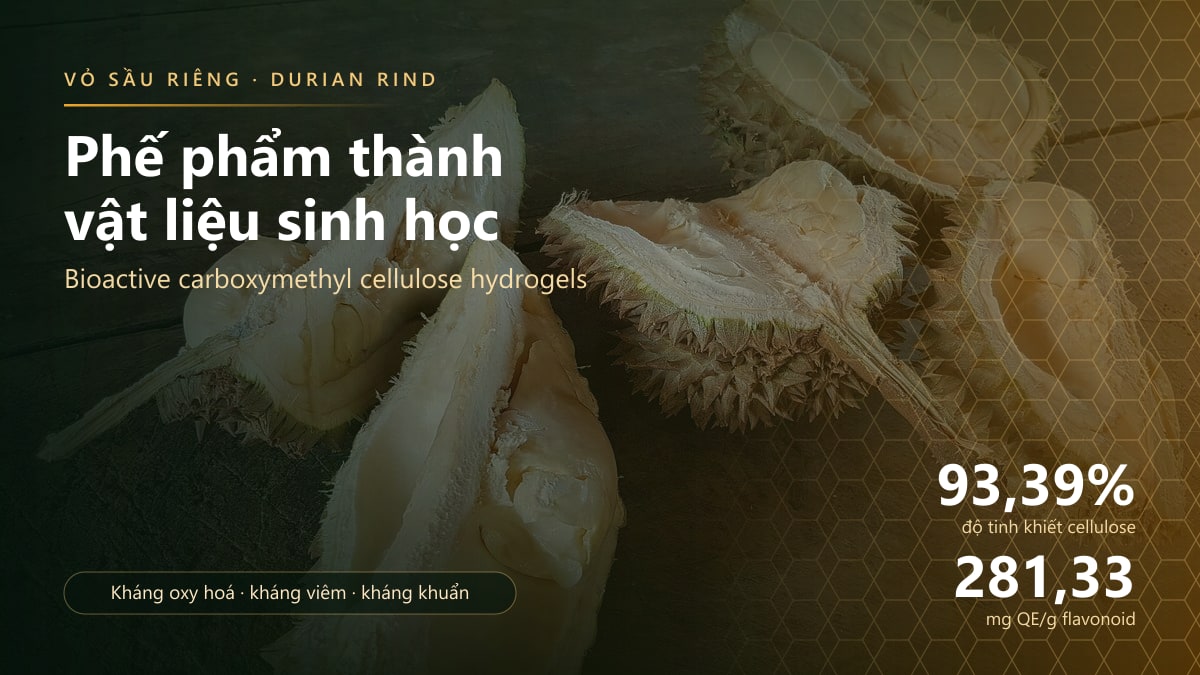
Dr Nguyễn Hoàng Chinh — Expert Advisor in Biotechnology at NIC AU, Deakin University, and recipient of Vietnam's Quả Cầu Vàng (Golden Globe) Award 2020 — is senior author of a paper published open access in Food Hydrocolloids (Elsevier), Volume 178, September 2026.
A waste stream Vietnam cannot keep burying
Vietnam is now one of the world's largest durian exporters, and the fruit arrives with an awkward companion: the rind accounts for roughly two-thirds of its weight. Hundreds of thousands of tonnes a year go to landfill or open burning, both of which cost money and emit methane or smoke.
The research answer so far has usually been to pick one valuable component out of the husk and discard the rest — which simply moves the waste problem one step down the line.
The approach: two products from one process
This study treats durian rind as two materials rather than one. A single integrated route extracts the flavonoids first, then takes the spent husk — the material that would normally be thrown away at that point — and converts it into cellulose, chemically modifies it into carboxymethyl cellulose, and casts the result into a hydrogel.
Nothing leaves the process as waste between the two steps. That is the structural idea, and it is also what makes the economics work.
The extraction medium turned out to matter more than expected. Citric acid at 10% outperformed the alternatives on both counts at once: it pulled out the most flavonoids and left behind husk in the best condition for cellulose recovery. It is also food-grade, cheap and benign, which a laboratory solvent generally is not.
The numbers
- 281.33 mg QE/g of total flavonoids recovered
- Cellulose at 27.10% yield and 93.39% purity
- The hydrogel released 65.34% of its payload over 24 hours — a controlled profile, not a burst
- Antioxidant activity: IC₅₀ of 55.75 µg/mL (DPPH)
- Anti-inflammatory activity: IC₅₀ of 610.70 µg/mL (BSA denaturation)
- Antibacterial: 10–14 mm inhibition zones against Staphylococcus aureus, Bacillus subtilis and Escherichia coli
The hydrogel is not an inert carrier that needs an active ingredient added to it. It is bioactive as made, because the flavonoid chemistry of the husk carries through into the final material.
The part most valorisation studies leave out
The paper closes with an economic evaluation of the integrated route. This is unusual, and it is the section that matters most for whether any of this ever leaves a laboratory bench. A process that works chemically but costs more than the product is worth is a publication, not a technology. Costing the route is what turns the first into a candidate for the second.
The team
Nine authors across Ton Duc Thang University (five), Deakin University (three) and Texas A&M University (one). Dr Nguyễn Hoàng Chinh holds the last author position — the senior, supervising role in this field's convention.
Bản tiếng Việt
TS. Nguyễn Hoàng Chinh — Cố vấn chuyên môn lĩnh vực Công nghệ sinh học của NIC AU, Đại học Deakin, chủ nhân Giải thưởng Quả Cầu Vàng 2020 — là tác giả cuối (tác giả chính chịu trách nhiệm) của bài báo công bố truy cập mở trên Food Hydrocolloids (Elsevier), tập 178, tháng 9/2026.
Một dòng phế phẩm Việt Nam không thể cứ chôn mãi
Việt Nam hiện là một trong những nước xuất khẩu sầu riêng lớn nhất thế giới, và loại quả này đi kèm một người bạn đồng hành phiền toái: phần vỏ chiếm khoảng hai phần ba trọng lượng quả. Mỗi năm hàng trăm nghìn tấn vỏ đi ra bãi rác hoặc bị đốt lộ thiên — cả hai đều tốn tiền và thải ra khí methane hoặc khói.
Hướng nghiên cứu phổ biến lâu nay là rút lấy một thành phần có giá trị trong vỏ rồi bỏ phần còn lại — tức là chỉ đẩy bài toán rác thải lùi thêm một bước.
Cách tiếp cận: một quy trình, hai sản phẩm
Nghiên cứu này coi vỏ sầu riêng là hai loại vật liệu chứ không phải một. Một tuyến quy trình tích hợp duy nhất chiết flavonoid trước, rồi lấy phần vỏ đã qua chiết — thứ mà thông thường sẽ bị bỏ đi ở bước này — chuyển thành cellulose, biến tính hoá học thành carboxymethyl cellulose, và tạo thành hydrogel.
Không có gì rời khỏi quy trình dưới dạng rác giữa hai bước. Đó là ý tưởng cốt lõi về mặt cấu trúc, và cũng là điều khiến bài toán kinh tế trở nên khả thi.
Môi trường chiết hoá ra lại quan trọng hơn dự đoán. Axit citric nồng độ 10% vượt trội trên cả hai tiêu chí cùng lúc: chiết được nhiều flavonoid nhất, đồng thời để lại phần vỏ ở trạng thái tốt nhất cho việc thu hồi cellulose. Nó còn là chất đạt chuẩn thực phẩm, rẻ và lành tính — điều mà dung môi phòng thí nghiệm thường không có.
Các con số
- Thu hồi 281,33 mg QE/g flavonoid tổng
- Cellulose đạt hiệu suất 27,10% với độ tinh khiết 93,39%
- Hydrogel nhả 65,34% lượng hoạt chất trong 24 giờ — đường cong nhả có kiểm soát, không ồ ạt
- Hoạt tính chống oxy hoá: IC₅₀ 55,75 µg/mL (DPPH)
- Hoạt tính kháng viêm: IC₅₀ 610,70 µg/mL (ức chế biến tính BSA)
- Kháng khuẩn: vòng vô khuẩn 10–14 mm trên Staphylococcus aureus, Bacillus subtilis và Escherichia coli
Hydrogel này không phải một chất mang trơ cần nạp thêm hoạt chất. Bản thân nó đã có hoạt tính ngay từ dạng chế tạo, vì hoá học flavonoid của vỏ quả đi xuyên suốt vào vật liệu cuối cùng.
Phần mà phần lớn nghiên cứu tận dụng phế phẩm bỏ qua
Bài báo khép lại bằng phần đánh giá kinh tế cho toàn tuyến quy trình tích hợp. Điều này không phổ biến, và đó lại chính là phần quan trọng nhất để trả lời câu hỏi liệu công nghệ có ra khỏi bàn thí nghiệm được hay không. Một quy trình chạy tốt về hoá học nhưng chi phí cao hơn giá trị sản phẩm thì đó là một bài báo, chưa phải một công nghệ. Tính được chi phí là bước biến cái thứ nhất thành ứng viên cho cái thứ hai.
Nhóm nghiên cứu
Chín tác giả thuộc Đại học Tôn Đức Thắng (năm người), Đại học Deakin (ba người) và Đại học Texas A&M (một người). TS. Nguyễn Hoàng Chinh giữ vị trí tác giả cuối — vai trò chủ trì, hướng dẫn theo thông lệ của lĩnh vực này.
Read the paper / Đọc bài báo gốc: Food Hydrocolloids — open access (doi:10.1016/j.foodhyd.2026.112630)
Full bilingual summary / Tóm tắt song ngữ đầy đủ: NIC AU Resources
Published open access under CC BY-NC-ND 4.0. The cover photograph above is "Opened durian (Philippines)" by Obsidian Soul, released into the public domain under CC0; the overlay was added by NIC AU. No figure from the paper is reproduced.