
Spotlight: NIC AU Academic Chair Dr. Nguyen Minh Triet Holds 2 Registered Korean Patents
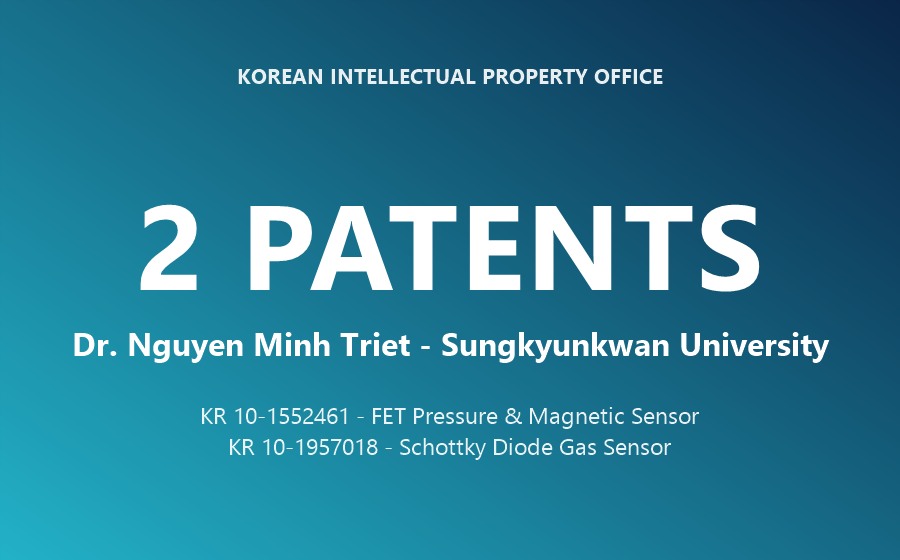
Long before he became NIC AU’s Academic Chair and a Biomedical Hardware Engineer at Archer Materials in Sydney, Dr. Nguyễn Minh Triết was in a semiconductor materials lab at Sungkyunkwan University (SKKU) in South Korea — co-inventing two devices that would go on to be officially registered as patents by the Korean Intellectual Property Office (KIPO).
NIC AU is proud to spotlight this achievement, and to place it in context for the Vietnamese scientific community: registered Korean patents naming a Vietnamese inventor are genuinely uncommon, and holding two from a single research group is rarer still.
The 2 Patents
1. KR Patent No. 10-1552461 — Field-Effect-Transistor-Type Sensor Capable of Measuring Pressure and Magnetic Field (registered 2015) A single transistor whose gate insulator blends piezoelectric materials (P(VDF-TrFE), BaTiO₃, PbTiO₃) with ferromagnetic materials (CoFe₂O₄, Fe₃O₄, NiFe₂O₄, BaFe₁₂O₁₉) — enabling one compact chip to measure pressure and magnetic field simultaneously, and to extract a magnetoelectric coupling coefficient in real time. Co-inventors: Lee Nae-Eung, Sakib Siddiqui, Nguyễn Minh Triết, Tran Quang Trung, Kim Do-Il.
2. KR Patent No. 10-1957018 — Schottky Diode Gas Sensor Using a Hybrid Structure of Metal Oxide Nanorods and Reduced Graphene Oxide (registered 2019) A gas sensor fusing 2D reduced graphene oxide with 3D zinc oxide nanorods on an AlGaN/GaN heterojunction, detecting NO₂, SO₂ and formaldehyde at room temperature down to 120 parts per billion, with response times as fast as 2 minutes — built for low-power IoT air-quality and industrial safety monitoring. Co-inventors: Lee Nae-Eung, Nguyễn Minh Triết, Jin-A Yang.
Read the full technical summaries on Resources.
Why This Stands Out
A globally recognised host institution. Sungkyunkwan University ranks among South Korea’s top 3–4 universities for materials science and engineering, and was designated by Korea’s Ministry of Science and ICT as one of only two core universities for the national Industrial-linked AI Semiconductor Talent Development Programme — earning it the label “cradle of semiconductor talent” in Korean higher education.
An elite research supervisor. Both patents were developed under Prof. Lee Nae-Eung, School of Advanced Materials Science and Engineering at SKKU — an internationally cited researcher (22,500+ citations, 350+ publications) working in graphene, nanocomposites, sensors and bioelectronics. Being named co-inventor on two of his lab’s patents places Dr. Triết’s work within a body of research recognised at the highest level of Korean materials science.
A rare feat for a Vietnamese scientist. Vietnam remains a modest player in international patent activity — the overwhelming majority of Vietnam-origin patent filings are domestic, and Vietnamese-named inventors on foreign patent registries such as KIPO are hard to find even with a targeted search. While no public registry tracks this figure precisely, the near-total absence of comparable cases is itself telling: two internationally registered semiconductor patents from a single Vietnamese researcher, years before he entered industry, is a genuinely unusual credential within the Vietnamese scientific community.
From the Lab to Industry — and Now to NIC AU
Dr. Triết’s patent work sits alongside a career that has since spanned physics, chemistry, semiconductor chips and microelectronics — including his current work at Archer Materials on a compact potassium sensor helping kidney and heart patients monitor blood potassium at home. As NIC AU’s Academic Chair, he now leads the scientific council for the AURORA Awards, bringing this same rigour to Vietnamese scientific talent in Australia.
Read more about Dr. Triết on the People page, and see previous coverage of his work in Tiền Phong and Vietnam News.