
NIC AU Research: Flexible Silicon Carbide Electrode Array Both Monitors and Ablates Cancer Cells
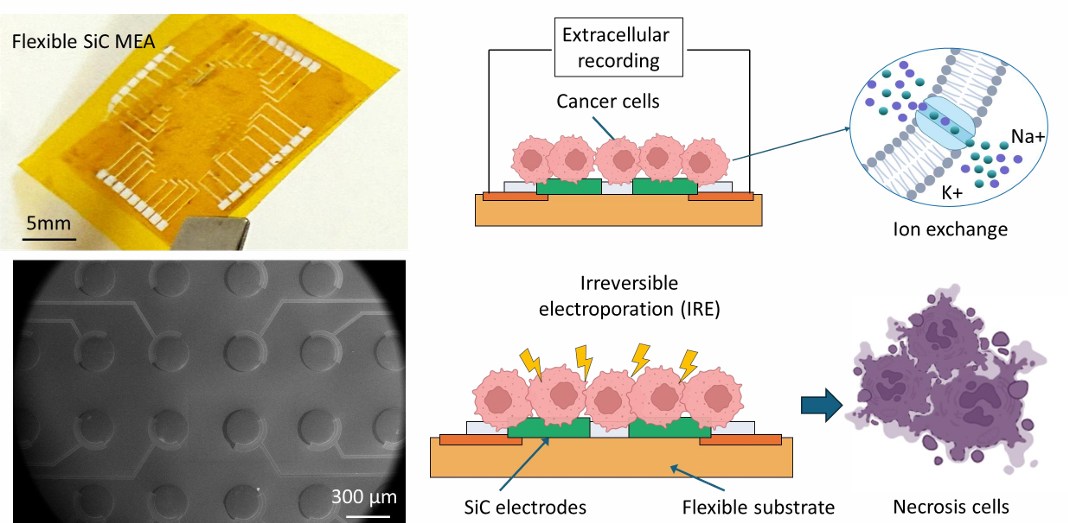
NIC AU congratulates Huỳnh Minh Anh (NIC AU), AURORA 2025 First Prize winner, on her latest first-author paper — “Flexible Implantable Silicon Carbide Multi-Electrode Array (MEA) for Cell Multichannel Recording and Cell Ablation” — published online 26 May 2026 in Advanced Materials Technologies (Wiley), alongside co-authors Matthew Barton, Sharda Yadav, Tuan-Khoa Nguyen and Nam-Trung Nguyen.
A Device That Both Listens and Acts
Most bioelectronic implants either sense or treat — rarely both. This work introduces a flexible, implantable silicon carbide (SiC) electrode array that does each in the same device: it continuously records multichannel electrical activity from cancer cells, then delivers targeted irreversible electroporation (IRE) to eliminate them, without relying on heat.
Built to Last Inside the Body
Leveraging SiC’s wide-bandgap stability, chemical inertness and biocompatibility, the array maintains near-unity signal transmission across 0.1–100 Hz even after 2,000 bending cycles. In tests on breast cancer cells (MDA-MB-231), it delivered stable multichannel recordings and successful localised cell ablation, while in vivo implantation confirmed no inflammation, fibrosis or adverse tissue response — a strong signal for long-term, precision-targeted cancer monitoring and treatment.
Read more on the Resources page or the published paper on Wiley Online Library.